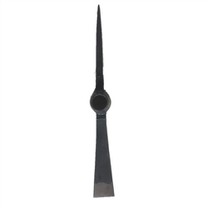
The shovel is a kind of production tool, which is widely used in production and life, and it is still an iron rice bowl for some niche groups today.
In terms of tracing, it must be traced back to the Stone Age. At that time, it was made with stones and used to plow the fields. The specific production process cannot be verified. We can talk about the meaning of the shovel to life in the 1980s and 1990s. At that time, every household would have a shovel, no matter how many acres of land you have, in addition to cattle farming, it is man-turned, and cattle farming is also the standard equipment for landlords and local tyrants. So whether it was possible to eat or not depended on it. At present, the application of shovel in life still exists, but the prosperity of the year is no longer there. This industry is also slowly dying. Today, with nostalgic feelings, I will show you the making of popular science shovel.
Intercept material
First of all, the shovel needs a certain degree of hardness and rigidity, and the steel is cut, and the cutting link is air cutting.
First, cut off the leftover material, and then cut the steel into equal parts.
Take this opportunity to give you the principle of popular science gas cutting: Gas cutting refers to the use of gas flame to preheat the cut metal to the ignition point, so that it burns violently in a pure oxygen stream to form molten slag and release a lot of heat. Under the action of blowing force, the oxidized slag is blown off: the heat released further preheats the next layer of metal to reach the melting point. The gas cutting process of metal is a continuous process of preheating, burning, and slag blowing. Its essence is a process of burning metal in pure oxygen, not a melting process.
Heating rolling
First, the steel is heated. The temperature is controlled at 1000~1200. The austenite crystals can only be formed when the temperature is above the A3 line, so the temperature must be heated to that temperature range.
The heating process is very slow and you need to wait patiently. After the heating is completed, the steel is forged first.
The forging machine desperately forges the steel, which will make the structure and performance of the steel more uniform. After the forging is completed, it comes to the rolling link.
To put it bluntly, it is to slowly adjust the gap of the rollers, so that the steel is rolled into thin slices. Such a workplace is also very dangerous, and it is not easy for workers. After rolling to a certain thickness, it needs to pass a set of rollers for precision pressing.
This group of rollers are precision pressed, which makes the thickness of the steel strip uniform. In this way, the production of the steel belt comes to an end.
Blanking, forming
The finished steel belt needs to undergo the first process-die blanking.
Through the engineers' fine calculations, the corresponding molds are made to punch the steel strip, and the blanks to be used before the final forming are obtained. Such a mold is actually very simple. The strip is punched into the corresponding model through the pressure transmitted by the punching machine. This mold is a bottom mold. After the punching is completed, the sheet material needs to be simply punched.
Reopening the mold is also a very simple mold. After the punching is completed, the billet needs to be heated.
The billet after heating needs to be formed immediately.